
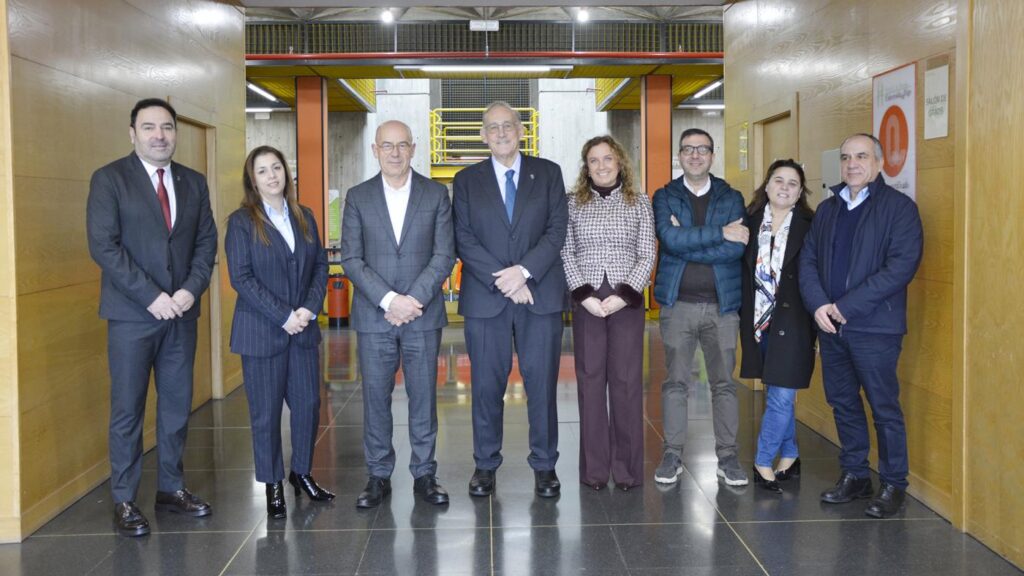
On 19 January, the Institute of Agroecology and Food (IAA) held a working meeting to make progress on the creation of the Iberian FoodTec Lab, the future Iberian laboratory in food sciences promoted by the University of Vigo and the Polytechnic Institute of Bragança. Additionally, the meeting took place at the Ourense Campus and helped define the next steps of this strategic cross-border project.
Purpose and Background of the Lab
The Iberian FoodTec Lab started as an initiative agreed upon by the governments of Spain and Portugal during bilateral summits. Its main goal is to strengthen research, innovation, and knowledge transfer in the agri-food sector. Over the past three years, the IAA and its partners have consolidated the scientific and institutional foundations through the European project Net4Food. This project receives funding from the POCTEP program (Interreg Spain–Portugal) and ERDF funds. As a result, the Galicia–Northern Portugal euroregion now has a strong cooperation network.
IAA’s Role and Expertise
The University of Vigo contributes through the IAA, reinforcing its position as a benchmark in agri-food research and sustainability. In particular, the Institute brings expertise in agroecology, food quality, sustainable production, and resource valorisation. Furthermore, this aligns with the specialization strategy of Campus Auga at the Ourense campus.
Next Steps and Future Goals
Following this meeting, the institutions are developing a consolidated proposal for the Iberian FoodTec Lab. They plan to present it at the next Spanish-Portuguese summit. Ultimately, the goal is for the laboratory to become an international reference hub in food science and technology. It will foster cooperation between universities, research centres, and the productive sector in the Galicia–Northern Portugal euroregion.
Commitment to Innovation and Sustainability
The IAA’s participation demonstrates its commitment to advancing research, transferring knowledge to society, and supporting a more innovative, resilient, and environmentally responsible local economy.
The full news article can be read on DUVI.