

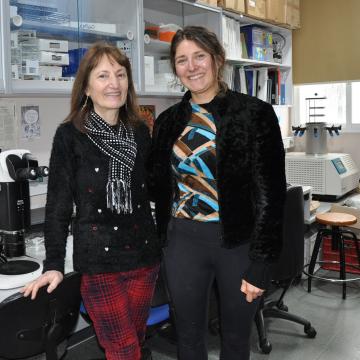
Pesticide contamination in European soils is the focus of an international study published in the journal Nature, involving researchers from the Institute of Agroecology and Food (IAA), María Jesús Iglesias Briones and Julia Köninger. The study reveals that 70% of European soils contain pesticide residues, with negative effects on biodiversity and soil ecosystem functions.
The research, involving ten European institutions, provides the first quantitative evidence of the prevalence and impact of pesticides used in agriculture on European soils. To this end, the researchers analysed 373 soil samples collected from agricultural fields, forests and grasslands across 26 countries, assessing the effects of 63 pesticides on different soil organisms.
Pesticides affect soil biodiversity
The results show that pesticide residues are not confined to agricultural land but are also present in forests and grasslands. Fungicides account for 54% of the active substances detected, followed by herbicides (35%) and insecticides (11%). Among the substances identified, glyphosate stands out as the most common active ingredient.
The study also demonstrates that these compounds can alter soil organism communities, including bacteria, fungi, nematodes and unicellular organisms. Among those most affected are mycorrhizal fungi, which play a key role in helping plants absorb water and nutrients and are therefore essential for crop development.
In addition to their effects on biodiversity, the study identifies changes in essential soil functions, such as nutrient cycling and the release of nutrients including phosphorus and nitrogen. These alterations may compromise soil ecosystem functioning and its ability to sustain agricultural production.
Towards better assessment of pesticide impacts
The findings highlight the need to expand current pesticide assessment systems by taking into account their effects on organism communities and soil functions, going beyond conventional laboratory tests based on individual species.
The study therefore contributes to a better understanding of the scale of pesticide contamination in European soils and provides evidence to support the development of regulations that take into account the effects of these substances on biodiversity and ecosystem functioning.
Read the full story published by DUVI (University of Vigo’s news service):